Your two-year-old points at everything but hasn’t said many words yet. Your mother-in-law says boys talk late. The family doctor says, “Let’s wait six months.” And you’re up at 1 a.m., scrolling through milestone charts.
We hear some version of this story almost every week. Most parents who come in for a developmental assessment aren’t even sure they need one. They just know something feels off, and they want a clear answer instead of more waiting.
This guide explains what a developmental assessment for child involves, when it makes sense, what it costs in Ahmedabad, and how to prepare your child so the visit goes smoothly.
Quick Answer A developmental assessment is a detailed, play-based evaluation of how your child moves, talks, understands, plays and behaves compared with typical milestones for their age. It is usually led by a developmental pediatrician, takes 1.5 to 3 hours, and ends with a written report and a clear plan. Book one if your child misses milestones or loses skills. |
What is a developmental assessment, and how is it different from a regular check-up?
A regular paediatric check-up looks at growth, vaccines and illness. A developmental assessment looks at how your child’s brain is developing across five areas: gross motor, fine motor, speech and language, thinking skills, and social-emotional skills.
The real difference is time and depth. A routine OPD visit lasts 10 to 15 minutes. A proper assessment gives the specialist time to watch your child play, ask detailed questions and use standardised tools that compare your child with large groups of children the same age.
And it isn’t only about autism. Children are assessed for speech delay, ADHD, learning difficulties, motor delays, and for follow-up after a premature birth or a NICU stay.
When should you book a developmental assessment for your child?
Book one when your child misses an expected milestone, loses a skill they already had, or when your gut keeps telling you something isn’t right. If a concern has lasted more than two or three months, don’t wait for it to “settle on its own”.
Here’s a simple guide based on widely used milestone checklists from the CDC and the Indian Academy of Pediatrics:
Age | Talk to a developmental specialist if your child… |
|---|---|
By 3 months | Doesn’t smile at people or follow moving objects with their eyes |
By 6 months | Can’t hold the head steady, doesn’t turn to sounds or laugh |
By 9 to 12 months | Can’t sit without support, doesn’t babble, doesn’t respond to their name |
By 18 months | Isn’t walking, has no meaningful words, doesn’t point to show you things |
By 2 years | Doesn’t use two-word phrases or copy your actions and words |
3 to 5 years | Speech is hard for family to understand, avoids playing with other children, has frequent intense meltdowns, or struggles with attention far more than peers |
Any age | Loses speech, social or motor skills they already had |
One more group we always suggest for assessment: babies born before 34 weeks, babies with low birth weight, and those who needed NICU care. A baseline check at around 6 to 12 months (corrected age) helps catch delays early, even when nothing looks wrong yet.
What happens during the assessment, step by step?
Most assessments follow the same broad flow. The exact tools depend on your child’s age and the concern you came in with.
- Detailed history. The doctor asks about pregnancy, birth, early feeding, sleep, milestones, family history and what worries you most. Bring old reports.
- Parent questionnaires. You may fill in short forms about your child’s behaviour, communication and daily routines at home.
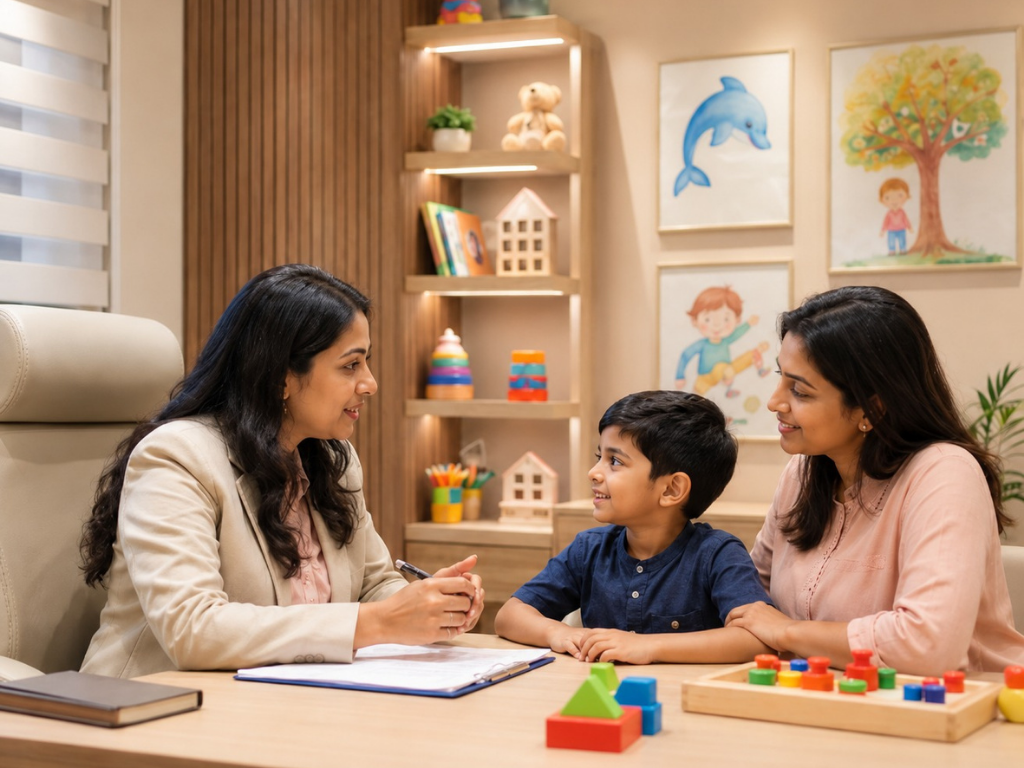
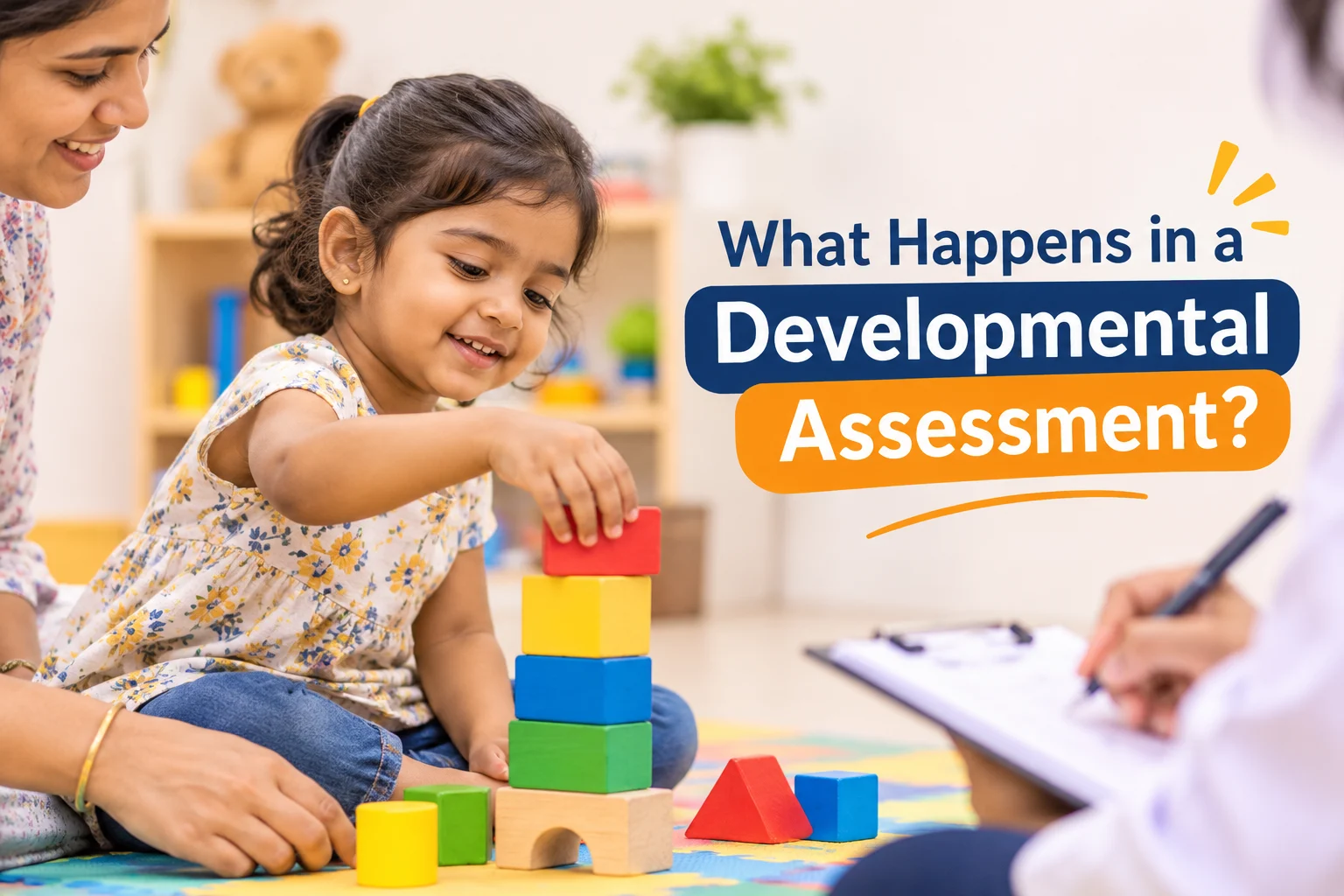
- Play-based observation. This is the part most parents don’t expect. Your child plays with blocks, picture books, puzzles and toys while the specialist watches how they move, communicate, solve problems and connect with you.
- Standardised testing. Depending on age, tools may include DASII (Developmental Assessment Scales for Indian Infants, used up to 30 months), the Developmental Screening Test, M-CHAT-R for autism screening, or adaptive behaviour scales.
- Hearing and vision checks. If speech is delayed, a hearing test (OAE or BERA) usually comes first. A child who can’t hear well can’t learn to talk well.
- Feedback and report. The doctor explains the findings, shares a developmental profile and suggests next steps. That could be therapy, further tests, or simply a review after a few months.
The whole process usually takes 1.5 to 3 hours. Some centres split it across two visits so the child isn’t worn out.
How much does a developmental assessment cost in Ahmedabad?
In Ahmedabad, a first consultation with a developmental pediatrician costs approximately ₹1,000 to ₹2,000. A full standardised assessment with a written report usually falls somewhere around ₹3,000 to ₹8,000, depending on how many tools are used and how many sessions it takes.
Hearing tests like BERA, detailed psychological testing, or IQ assessments for school-age children are often charged separately.
A quick tip: ask exactly what’s included before you book. Some quotes cover only the consultation, not the report. Fees also change over time, so call the centre for current pricing.
How can you prepare your child for the assessment?
Keep it simple. Your child doesn’t need to “perform”, and you shouldn’t try to make them.
- Pick a time when your child is usually alert, not nap time or straight after school.
- Carry a snack, water and one favourite toy.
- Bring past reports, the birth discharge summary and the vaccination card.
- Record short phone videos of behaviours that worry you. Children often act differently in a new room.
- Write down your top questions before you arrive, so nothing gets forgotten.
Common mistakes parents make
The biggest one is waiting too long because a relative said “he’ll grow out of it.” Some children do catch up. Many need support, and the earlier it starts, the more the young brain can adapt.
Another is coaching the child before the visit (“Say apple for the doctor!”). It’s a natural instinct, but it hides the real picture. Let the specialist see your child as they are.
And try not to compare with a cousin or the neighbour’s child. Development has a normal range, and a good assessment tells you where your child sits within it.
How Samvedan Child Development Centre handles developmental assessments
At Samvedan Child Development Centre, assessments are led by Dr. Purva Shah, a developmental pediatrician (MBBS, MD, PGDDN) with DASII training and child mental health training from NIMHANS.
We start by listening. Parents often arrive with a long list of worries and a few conflicting opinions from family, so the first part of the visit is mostly about understanding your child’s story.
Observation happens in a play setting, and parents stay in the room. Children settle faster that way, and you get to see what we’re seeing.
If therapy is needed, the plan connects directly to our in-house team for speech therapy, occupational therapy, physiotherapy, behavioural support and parent counselling. Fewer handovers, one team tracking progress.
Families can visit us at South Bopal or Chandkheda in Ahmedabad, or at Manjalpur in Vadodara.
Frequently Asked Questions
Q1. At what age can a child have a developmental assessment?
A developmental assessment can be done at any age from early infancy through adolescence. Infant tools like DASII work from the first weeks of life up to 30 months. For older children, the focus shifts to language, learning, attention and behaviour. If you have a concern, no age is too early to get it checked.
Q2. Is a developmental assessment the same as an autism test?
No. Autism screening can be one part of it, but a developmental assessment looks at the full picture: motor skills, speech, understanding, play, behaviour and social skills. Many children brought in for suspected autism turn out to have a speech delay, a hearing issue or another concern, and the assessment helps tell these apart.
Q3. How long does it take to get the developmental assessment report?
Most parents get verbal feedback on the same day. A detailed written report usually takes approximately 3 to 7 working days, depending on how many tests were done. It includes your child’s developmental profile, findings in each area and recommended next steps, which you can share with the school or therapists.
Q4. Will my child need medication after a developmental assessment?
Most children don’t. The usual outcome is a therapy plan, such as speech therapy, occupational therapy or behavioural support, along with home activities for parents. Medication is considered only for specific conditions, like some cases of ADHD, epilepsy or anxiety, and only after the doctor discusses the options with you in detail.
Q5. Should a premature baby have a developmental assessment even if they seem fine?
Yes, it’s a sensible step. Babies born premature, with low birth weight, or who needed NICU care have a higher chance of developmental delays. A baseline assessment at around 6 to 12 months of corrected age helps pick up small gaps early, when support can make the most difference.
Ready to get a clear answer?
If something about your child’s development is bothering you, trust that feeling. A developmental assessment doesn’t put a label on your child. It gives you facts, a plan and a team to talk to.
Many parents tell us the hardest part was booking the first appointment. Everything after that felt clearer.
If you’re in Ahmedabad or Vadodara and want to talk through your concerns, reach out to Samvedan Child Development Centre at South Bopal, Chandkheda or Manjalpur. A short call is often enough to decide whether an assessment is the right next step for your child.